
Every software modernization conversation today eventually arrives at the same question:
“If AI can write code, why can’t it modernize legacy systems?”
It’s a reasonable question.
After all, large language models can explain COBOL, generate Java, write tests, and summarize decades-old business logic in seconds. The productivity gains are real.
But there’s an important distinction that many modernization discussions miss:
Understanding a legacy system and transforming a legacy system are not the same problem.
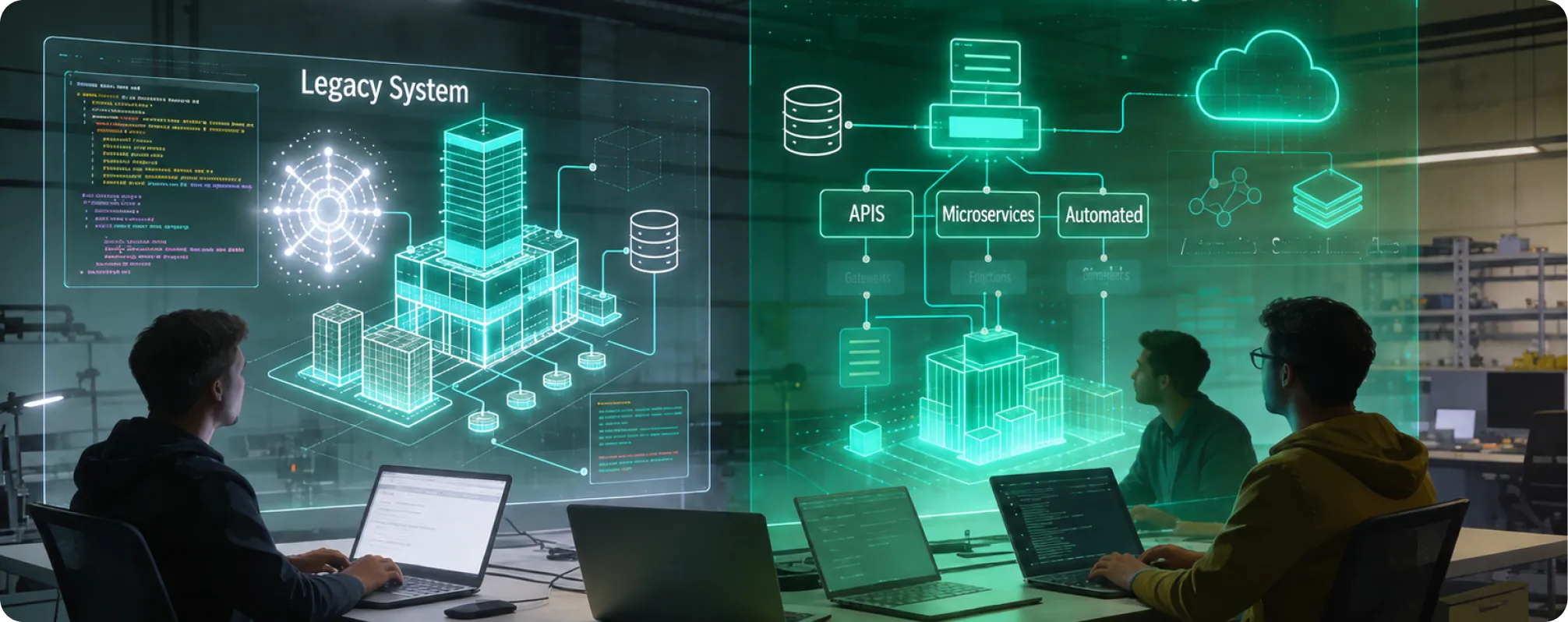
The organizations seeing the greatest success with AI-powered modernization have learned to separate those two activities.
GenAI excels at understanding, documenting, and accelerating modernization work.
Deterministic transformation excels at converting software systems accurately, consistently, and at scale.
The future of modernization is not GenAI versus deterministic transformation.
It is both working together.
Why Legacy Modernization Is Different
Most enterprise software wasn’t designed to be replaced.
Many critical systems have evolved over decades, accumulating thousands of business rules, integrations, operational procedures, and edge cases that were never formally documented.
The challenge is not simply moving from COBOL to Java or from a mainframe to the cloud.
The challenge is preserving the business behavior encoded in the application while modernizing the technology around it.
That requires more than code generation.
It requires understanding, validation, and transformation at scale.
Where GenAI Delivers Real Value
GenAI has changed modernization programs in important ways.
It can:
- Explain unfamiliar legacy code
- Generate documentation
- Surface candidate business rules
- Assist with test creation
- Review transformed code
- Accelerate system discovery
Tasks that once required months of manual investigation can often be completed in days or weeks.
For organizations facing retirement of legacy-system experts, this is transformative.
The value is real.
Where GenAI Reaches Its Limits
The challenge begins when the objective changes from:
“Help me understand this system”
to
“Create a replacement system that behaves exactly like the original.”
Large language models generate output based on probability.
That makes them excellent assistants.
It does not automatically make them reliable system-transformation engines.
Large-scale modernization introduces requirements that are difficult to satisfy with probabilistic generation alone:
- Consistency across millions of lines of code
- Repeatable results
- Traceability
- Auditability
- Functional equivalence
For regulated, financial, government, and mission-critical systems, those requirements matter as much as speed.
The Role of Deterministic Transformation
This is where deterministic software transformation enters the picture.
Instead of generating code from statistical patterns, deterministic transformation analyzes software using formal language definitions, program analysis, and explicit transformation rules.
The same input produces the same output every time.
The modernization process becomes repeatable, traceable, and auditable.
This approach has been used successfully for decades on large-scale software modernization efforts involving millions of lines of code and complex legacy ecosystems.
The Future Is Combining Both
The strongest modernization programs increasingly combine the strengths of both approaches.
GenAI accelerates:
- Discovery
- Documentation
- Business-rule extraction
- Test generation
- Review
Deterministic transformation handles:
- Code conversion
- Architectural transformation
- Consistency
- Repeatability
- Functional-equivalence validation
Each technology contributes where it is strongest.
Neither replaces the other.
What This Means for Organizations Planning Modernization
The question is no longer whether AI belongs in modernization.
It does.
The more important question is where AI should be trusted and where deterministic methods should remain in control.
Organizations that separate those responsibilities tend to achieve better outcomes:
- Faster assessments
- Better documentation
- Lower project risk
- More maintainable systems
- Greater confidence in the final result
Modernization Beyond Translation
At Modernize Software, we use GenAI to accelerate discovery, documentation, test generation, and system understanding.
The modernization itself is performed through deterministic software transformation technology designed to deliver repeatable, auditable results at enterprise scale.
The goal is not simply to convert code.
The goal is to transform legacy applications into modern, maintainable systems while preserving the business logic that makes those applications valuable.
That’s where AI creates value. And that’s where modernization becomes sustainable.
.png)

 info@semanticdesigns.com
