
Legacy software modernization: the complete technical guide for 2026
Legacy software modernization is the process of moving business-critical applications away from technology that has become costly, risky, or difficult to maintain—without losing the business behavior those applications must preserve.
The decision to modernize is often straightforward. Executing it successfully is much harder. The greatest risks are rarely limited to the programming language or platform. They usually lie in undocumented business rules, data semantics, hidden dependencies, and interfaces that have evolved over years of production use.
Successful modernization begins with understanding what the existing system actually does, selecting an approach suited to the business and technical requirements, and establishing how the new system will be proven equivalent where behavior must remain unchanged.
This guide explains how to evaluate modernization options, assess legacy systems, choose the right transformation approach, manage technical risks, and measure the business case. It also examines where deterministic software transformation and generative AI each contribute to a successful modernization program.
It also covers where deterministic transformation and generative AI each belong, how projects fail, how to frame ROI, and where to go next for each legacy technology.
Key takeaways
- A legacy system is better defined by its cost and risk of change than by its age. Ten-year-old Java can be more "legacy" than well-maintained COBOL.
- There are eight most common strategies for modernization: retain, rehost, replatform, automated translation, rearchitect, rewrite, replace with SaaS and retire. Most estates need more than one.
- The migration itself is a pipeline: assessment, inventory, translation, data, interfaces, testing and cutover. Data and testing often dominate the schedule.
- Deterministic, rule-based transformation is usually the better fit for producing the translated code; GenAI is useful around it for documentation, analysis and test generation.
- Projects fail on scope, data and proof of equivalence far more often than on language syntax.
- ROI holds up best when you compare against the real cost of standing still, including risk.
What is legacy software modernization?
Legacy software modernization is the process of changing a business-critical application's language, platform, data stores or architecture so it can be operated, secured and changed at acceptable cost, while preserving its externally observable behavior. It spans options from rehosting unchanged code to automated translation, rearchitecting, replacement and retirement.
The definition has two halves, and both matter. "Operated, secured and changed at acceptable cost" is the business goal. "Preserving externally observable behavior" is the engineering constraint. A project that delivers new technology but changes how interest is rounded, how a report sorts or how a flight-control mode transitions has not modernized anything. It has introduced defects.
What is a legacy system?
A legacy system is software that still performs a critical function but whose cost, risk or lead time for change has become disproportionate to the value of the change. Age is a weak proxy. The real markers are structural:
- Shrinking skill pool. Few people can safely modify it, and they are often near retirement.
- Unsupported dependencies. The language runtime, compiler, OS, database or hardware has left vendor support or is about to.
- Coupling you cannot see. Behavior depends on copybooks, shared files, job ordering, global state or platform quirks that were never fully documented.
- No safety net. Tests are thin or absent, so most changes carry production risk.
- Platform lock. It only runs on one class of hardware or one vendor's middleware.
By that definition, a 2012 Java monolith with no tests and a framework two major versions behind can be legacy. A well-tested COBOL batch suite with an active team and a supported compiler may not be, at least not yet.
What is legacy code?
Legacy code is the source code that implements a legacy system: the programs, copybooks, job streams, stored procedures, macros, scripts and generated code. A useful working definition for engineers is "code you cannot change with confidence." That is why understanding comes first. Before choosing an approach, you need legacy code analysis and business rules extraction that tells you what the code does today, not what the 1998 design document says it does.
Modernization vs migration
The terms overlap but are not synonyms. Migration moves something from A to B: code to a new language, data to a new database, workloads to a new platform. Modernization is the broader outcome, a system that is cheaper and safer to change. You can migrate without modernizing (lift-and-shift keeps the same code with a new bill) and modernize without migrating (refactoring C++98 to modern C++ in place).
Signs a legacy system needs modernizing
Very few systems need legacy software modernization "because they are old." The ones that do usually show several of the following signals at once. Score each one honestly before committing budget.
1. Skills risk
When the people who understand the system retire, the cost of change rises and the risk around incidents increases. The US Government Accountability Office's July 2025 review of federal systems, GAO-25-107795, identified 11 legacy systems most in need of modernization, ranging from 23 to 60 years old. Eight of the 11 used outdated languages, and GAO noted that both Treasury systems run on COBOL and assembly language code with a dwindling pool of people able to support them. The private sector shows a similar curve; it just publishes less about it. We cover the staffing side in the legacy code talent shortage.
2. Support lifecycle deadlines
Vendor support dates are among the most objective signals you have, because they convert a vague risk into a calendar entry. A few that matter right now:
| Technology | Support status | Source |
|---|---|---|
| IBM z/OS 2.5 | End of support 30 September 2026 (extended support is a separate paid offering) | IBM product lifecycle page |
| Visual Basic 6.0 IDE | Unsupported since 8 April 2008; runtime supported only for serious regressions and critical security issues, for the life of supported Windows versions | Microsoft Learn VB6 support statement |
| Adobe ColdFusion 2021 | Core support ended 10 November 2025; extended support ends 10 November 2026 | Adobe end-of-life matrix |
A support deadline does not force a rewrite. For z/OS, an upgrade within the platform is often the right answer, as our note on the z/OS 2.5 end of support explains. For VB6, Microsoft's own statement says there is no supported way to create or maintain VB6 applications and recommends replacing them.
3. Security exposure
Unsupported software no longer receives vendor patches, and legacy code often predates modern authentication, encryption and logging. CISA lists the use of unsupported or end-of-life software in service of critical infrastructure on its catalog of bad practices. In GAO's discussion of the 2025 report, the agency said seven of the 11 critical federal systems had known cyber vulnerabilities and eight could not implement newer techniques such as zero trust (GAO Watchdog transcript).
4. Run cost
GAO reports that the federal government spends over $100 billion a year on IT, and agencies have typically reported about 80 percent of that going to operations and maintenance of existing systems. Your ratio may differ, but measure it: MIPS or MSU charges, middleware licenses, specialist contractor rates, and the cost of hardwaref you cannot replace. If cost is the main problem on a mainframe, reducing MIPS without leaving the mainframe may beat a migration.
5. Change velocity
This is often the signal executives feel most. If a regulatory change that should take two weeks takes a quarter because of regression risk, the system is taxing every product decision. Track lead time for change, change failure rate and the backlog of deferred requests for the system specifically.
Quick self-assessment checklist
- Fewer than three people can safely change the core programs.
- At least one runtime, compiler, OS or database is out of support within 24 months.
- Security findings are closed with compensating controls rather than fixes.
- Run cost is growing faster than transaction volume.
- Change lead time is measured in months, not weeks.
- Nobody can produce an accurate inventory of programs, jobs, files and interfaces.
Three or more checks usually justify a formal assessment. One or two may justify nothing beyond monitoring, which is a legitimate decision we discuss in when not to modernize legacy systems.
Legacy system modernization approaches: the full menu
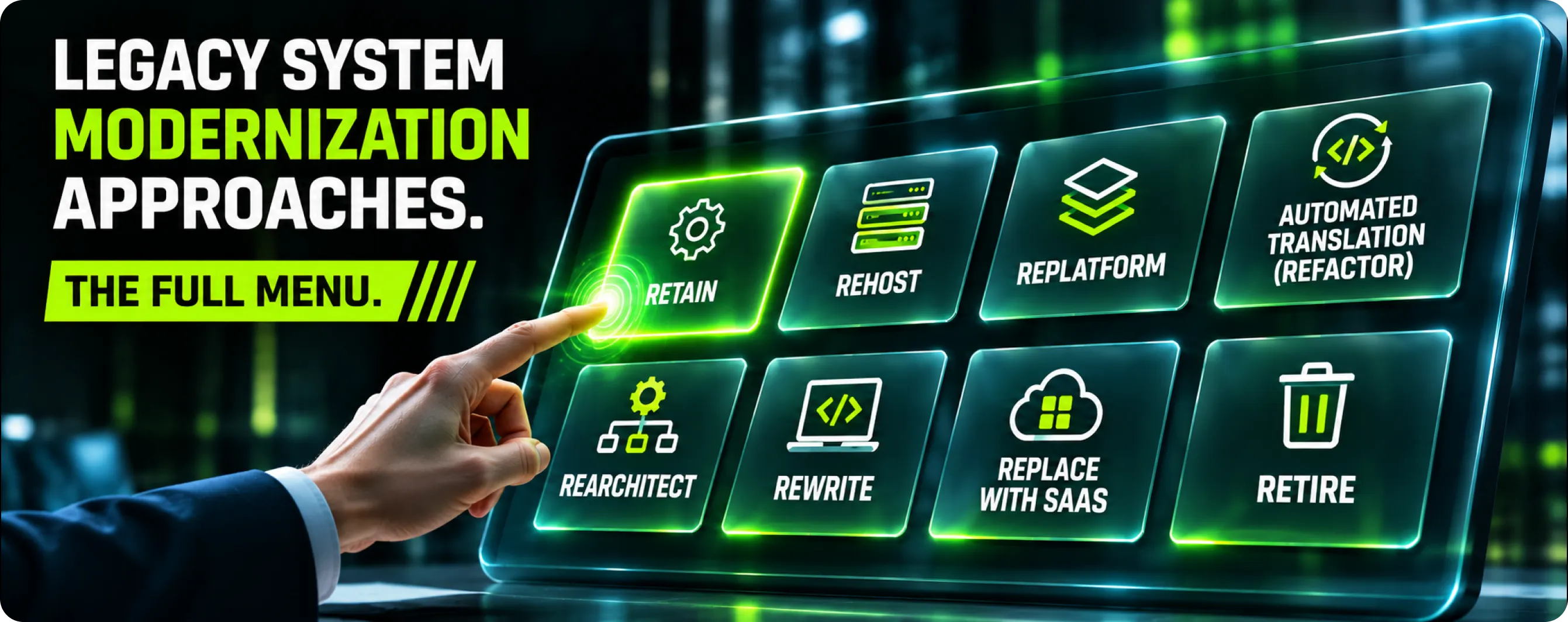
Cloud providers popularized the "7 Rs" framing. AWS Prescriptive Guidance, for example, lists retire, retain, rehost, relocate, repurchase, replatform and refactor or re-architect (AWS migration strategies). That framing is built around moving workloads to a cloud. For legacy software modernization, it hides the distinction that matters most: whether the source code is translated by a machine, rewritten by people, or left alone. Here is the menu we use.
Retain
Keep the system as is, with targeted investment in documentation, tests, observability and security controls. Retain is right when the system is stable, rarely changes and its platform is supported. It is not "do nothing"; it is "do the minimum deliberately."
Rehost
Run the same code on different infrastructure, for example a mainframe workload on an emulated or recompiled runtime on x86 or in a cloud. Rehost is fast and low-risk for behavior because the code does not change. It also leaves the language, skills problem and much of the architecture exactly where they were, and it can raise cloud bills, as we covered in why cloud costs rise after modernization.
Replatform
Change the platform underneath while making modest code changes: a new database engine, a new application server, a supported OS. A ColdFusion app moved from Adobe ColdFusion to Lucee, or a Db2 database moved to PostgreSQL with SQL dialect fixes, are typical replatforms.
Automated translation (refactor)
Convert the source language to a modern one with tools that parse the code, analyze it and apply transformation rules, then restructure the output for maintainability. Done well, this preserves behavior, scales to millions of lines and produces code your team owns. Done badly, it produces "COBOL written in Java." The quality of the transformation engine and its post-translation refactoring decide which you get.
Rearchitect
Change the structure: split a monolith into services, replace batch with event streams, move a pseudo-conversational CICS application to stateless REST APIs. Rearchitecting delivers the largest long-term change in agility and the largest risk. It works best after translation, when the code is in a language your team can safely refactor.
Rewrite
Re-implement from requirements, by hand. A rewrite makes sense when the old system's behavior is no longer what the business wants, when the codebase is small, or when the domain is simple and well documented. For large systems it is the highest-risk option, because the requirements are in the code and a rewrite discards them.
Replace with SaaS
Buy a commercial product (payroll, general ledger, CRM, HR) and migrate the data. Correct when the function is not a differentiator and the package fits without heavy customization. Customizing a package until it mimics the legacy system recreates the legacy problem with a subscription attached.
Retire
Turn it off. Every portfolio has applications with few users, duplicate functions or no inbound traffic. Retiring them is the cheapest modernization there is, and it shrinks the scope of everything else. Archive the data with a retention plan, and confirm no batch job, report or downstream feed still reads from it.
Choosing a legacy modernization strategy: an honest decision table
A legacy modernization strategy is usually a portfolio decision, not a single choice. The table below summarizes when each approach fits and where it tends to break. A longer treatment of the mainframe-specific trade-offs is in rehost vs refactor vs rearchitect for mainframes.
| Approach | What changes | Pick it when | Avoid it when | Main risk |
|---|---|---|---|---|
| Retain | Nothing structural | Stable, supported, rarely changed | Skills or support are about to disappear | Deferred risk accumulates |
| Rehost | Infrastructure only | Hard deadline on hardware or a data center exit | The real problem is language, skills or agility | Same code, new bill |
| Replatform | Runtime, DB or OS; minor code | Platform is the problem, code is fine | Code relies on platform-only features | Dialect and behavior drift |
| Automated translation | Language and runtime, behavior preserved | Large, valuable codebase with embedded rules | Behavior itself must change | Unreadable output from weak tools |
| Rearchitect | Structure and interfaces | Agility or scale is the binding constraint | Team cannot yet change the code safely | Scope explosion |
| Rewrite | Everything | Small system, or business process is changing anyway | Large system with undocumented rules | Lost business rules, overrun |
| Replace with SaaS | Application ownership | Commodity function, package fits | Function differentiates you | Customization debt |
| Retire | System is removed | No users, duplicate function | Hidden consumers exist | Broken downstream feeds |
Two practical rules sit on top of the table. First, sequence matters: translate first, then rearchitect in a language with a large talent pool and modern tooling. Second, the strangler fig pattern helps with incremental cutover but has its own failure mode, which we describe in why strangler fig migrations stall.
The technical anatomy of a legacy migration
Whatever approach you choose for a given application, the execution of legacy software modernization follows the same pipeline. The mainframe version of this pipeline, with sequencing and decommissioning, is the subject of our mainframe migration strategy playbook. The general shape is below.
- Assessment. Parse the whole codebase, not a sample. Measure size, complexity, dialects, dead code, clones and dependencies. Output: a complexity report, an automation estimate and a risk register.
- Inventory. List every artifact: programs, copybooks, includes, job control, schedules, utilities, screens, files, databases, queues, reports and external interfaces. The non-code items are the ones that surprise teams late; see everything on the mainframe that is not COBOL.
- Translation. Convert source languages to the target with behavior preserved, then restructure. This includes control flow (GOTO and fall-through), data types, file I/O semantics, transaction APIs and error handling.
- Data. Convert file and database formats, encodings and types, then load and reconcile. Mainframe stores need specific handling, covered in migrating VSAM, IMS and Db2 data.
- Interfaces. Reproduce every contract the system has with the outside world: file layouts, message formats, APIs, terminal screens, print streams, sort orders and timing.
- Testing. Prove functional equivalence with captured production inputs, parallel runs and record-level comparison. This is the gate that decides go-live.
- Cutover. Choose big-bang or phased, rehearse it, define rollback criteria and decommission the old platform.
Where the semantics hide: a numeric example
Data types are the most common source of silent defects. Consider this COBOL fragment:
01 WS-BALANCE PIC S9(7)V99 COMP-3.
01 WS-RATE PIC SV9(5) COMP-3.
01 WS-INTEREST PIC S9(5)V99 COMP-3.
COMPUTE WS-INTEREST ROUNDED = WS-BALANCE * WS-RATE.
A naive translation uses double, which cannot represent most decimal fractions exactly and ignores both the rounding rule and the field size. A faithful Java translation looks like this:
// PIC S9(5)V99: 5 integer digits, 2 decimal places
BigDecimal interest = balance.multiply(rate)
.setScale(2, RoundingMode.HALF_UP); // COBOL ROUNDED = half away from zero
interest = interest.remainder(new BigDecimal("100000")); // drop high-order digits, keep sign
The second line matters. Without an ON SIZE ERROR clause, a result too large for a packed-decimal receiving field typically loses its high-order digits with no error raised, so 123456.78 lands as 23456.78. Confirm the exact behavior for your compiler and options before encoding it. Whether the translated program should reproduce that truncation or raise an error is a business decision, but it must be a decision, not an accident. Binary (COMP) fields add another layer, because their truncation also depends on the TRUNC compiler option. The full mapping of PIC clauses, COMP-3, REDEFINES and OCCURS DEPENDING ON is in our reference on COBOL data types in Java and C#.
The same field on disk is packed decimal. A value of +1234.56 in a PIC S9(5)V99 COMP-3 field occupies four bytes, X'0123456C', where the final nibble C is the sign. Any data migration that treats that field as text corrupts it.
Control flow and transaction semantics
Legacy programs often depend on GOTO, PERFORM THRU ranges and paragraph fall-through. Translators that map these line by line produce code nobody can maintain. Control-flow analysis can restructure them into structured loops and conditionals while preserving behavior, which is the topic of restructuring spaghetti code and GOTO.
Online programs carry transaction semantics too. A CICS program's COMMAREA, pseudo-conversational flow and syncpoints need explicit equivalents in Spring Boot or ASP.NET Core; see CICS migration to Java and .NET. Batch has its own contract: dataset dispositions, condition codes, generation data groups and sort steps, covered in JCL migration to modern batch.
Proving equivalence
Testing is where schedules are won or lost. Unit tests rarely exist for legacy code, so the practical baseline is the system itself: capture real inputs, run old and new side by side, and compare outputs record by record, including sort order and rounding. Encoding differences alone can change report order, as described in our post on EBCDIC to ASCII sort order. The method is set out in detail in data migration testing and functional equivalence.
Deterministic transformation vs GenAI
Large language models changed the conversation about legacy application modernization, and they are useful. The question is which job they do. Translating a million lines of code that must behave identically is a different job from explaining what a program does.
| Task | Deterministic transformation | GenAI |
|---|---|---|
| Translating production code at scale | Strong: same input, same output; rules are inspectable | Inconsistant: output varies by run and can hide logic errors |
| Preserving numeric and file semantics | Strong when the rules encode them | Inconsistent; easy to miss truncation or sort order |
| Explaining code, drafting documentation | Limited | Strong, with human review |
| Business rule extraction | Labor intensive for extraction: locating and generating "human-readable rules." Strong at rules preservation through deterministic like-for-like conversion | Good for summarizing it in plain language |
| Generating test scenarios | Helpful with test coverage information | Good at test case creation based on generated business rules. Unknown what is not tested or tested incorrectly |
| Small, one-off subsystems | Overkill | Often the fastest option |
The core issue is verifiability. A deterministic engine applies the same rewrite rules every time, so a defect found once is fixed once, in the rule, everywhere. A probabilistic generator can produce correct code in one file and subtly different code for an identical pattern in the next. Do the arithmetic on a hypothetical: a generator that gets 95 percent of programs right still leaves 1,000 defective programs in a 20,000-program estate, and you do not know which ones. We go further into the limits in why GenAI alone is not enough for modernization.
How DMS handles translation, and where it stops
Modernize Software's DMS (Design Maintenance System) is a program-transformation engine built on full language grammars, control-flow and data-flow analysis, and composable rewrite rules. Semantic Designs (Modernize Software’s parent company) has run DMS in production since 1995. DMS supports 40+ source languages and dialects and has processed more than 500 million lines of code. Key DMS features include:
- Deep structural understanding. Parsing the source into a representation that supports analysis of program structure, control flow, data flow, and dependencies.
- Extensible transformation rules. Adapting translators to additional language dialects, customer-specific constructs, and surrounding technologies rather than assuming every installation conforms to one standard.
- Predictable, repeatable transformation. Applying validated rules consistently across a large codebase, with exceptional or ambiguous constructs identified for engineering review.
Two limits are worth stating plainly. First, constructs that cannot be translated deterministically, such as self-modifying assembler or behavior that depends on undocumented runtime quirks, are flagged for engineer review rather than guessed. Second, a translator preserves behavior; it does not decide whether that behavior is still correct for the business. That judgment belongs to your domain experts. GenAI is used for translation for documentation, analysis and test generation, not to write the translated code. The mechanics are described in how deterministic software transformation works.
Every legacy technology, mapped to its migration path
Each legacy stack has its own semantics to preserve. This table maps each one to the deep-dive post in this guide and the matching service.
| Legacy technology | What makes it hard | Typical targets | Deep dive | Service |
|---|---|---|---|---|
| COBOL (batch and online) | Decimal arithmetic, copybooks, dialects | Java, C# | Is COBOL still used? | COBOL modernization, COBOL to Java, COBOL to C# |
| CICS | Pseudo-conversational state, COMMAREA, BMS maps | Spring Boot, ASP.NET Core | CICS transactions in Java and .NET | COBOL to Java migration services |
| JCL | DISP, COND codes, GDGs, sort steps | Spring Batch, Airflow, cloud schedulers | Converting JCL batch jobs | Mainframe COBOL modernization |
| VSAM, IMS, Db2 | Packed data, hierarchical segments, EBCDIC | PostgreSQL, SQL Server, Oracle | VSAM, IMS and Db2 data migration | COBOL and data modernization |
| PL/I and HLASM | Pointer-heavy PL/I, macros, register usage | C, Java, C# | PL/I and HLASM modernization | Proprietary and niche language migration |
| Natural/ADABAS | MU/PE fields, descriptors, inverted lists | Java or C# with SQL | Natural and ADABAS migration | Natural/ADABAS to Java, ADABAS to C# |
| HPE NonStop (Tandem) | TAL/pTAL, Pathway, Enscribe, process pairs | C, Java, modern middleware | Tandem modernization explained | HPE NonStop modernization |
| VB6 | Variants, On Error, OCX controls, ADO | C#, VB.NET | VB6 to .NET technical guide | VB6 to .NET migration |
| ColdFusion | Dynamic CFML scopes, tag semantics | Java, Lucee | ColdFusion to Java guide | ColdFusion to Java migration |
| Fortran | COMMON blocks, EQUIVALENCE, implicit typing | Modern Fortran, C++ | Modernizing Fortran 77 | Fortran modernization |
| Ada | Tasking, strong typing, certification evidence | Modern Ada, C++ | Ada 83 in safety-critical systems | Ada modernization |
| JOVIAL | Tables, overlays, real-time constraints | C, C# | JOVIAL history and migration | JOVIAL migration |
| Legacy C++ | C++98 idioms, raw pointers, God classes | Modern C++ | Moving C++98 to modern C++ | C++ modernization |
| Proprietary DSLs, SabreTalk | No public grammar, no tools, no people | C, Java, C# | How a custom translator is built | Custom translator development, SabreTalk migration |
Why legacy software modernization projects fail
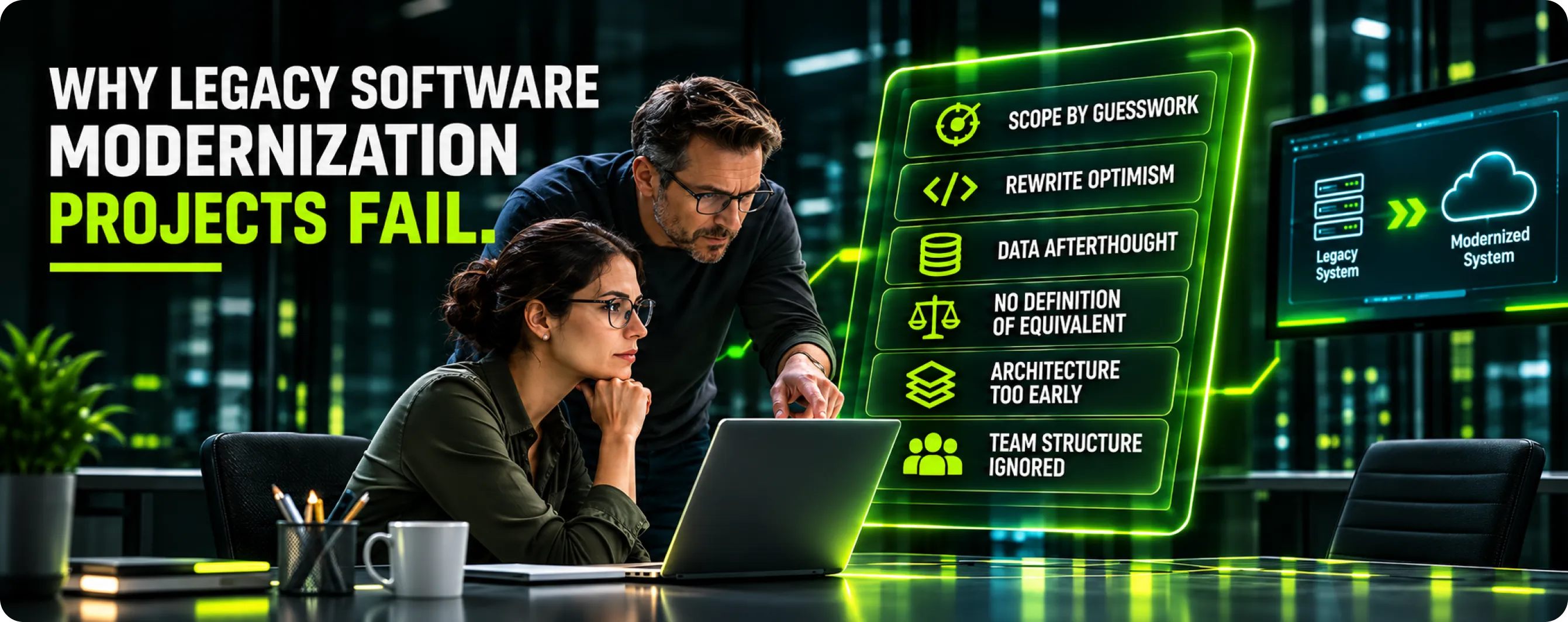
The failure patterns are remarkably consistent, and few of them are about syntax.
- Scope defined by guesswork. Estimates based on a sample of programs miss the long tail: utilities, dynamic calls, assembler subroutines and vendor tools. Parse everything before you price anything.
- Rewrite optimism. Teams assume the requirements are known. They are in the code, and a rewrite rediscovers them one production incident at a time.
- Data treated as an afterthought. Encoding, packed fields, redefined records and dirty historical data often consume more time than code conversion on mainframe projects.
- No definition of "equivalent." Without agreed comparison rules for rounding, sort order and timestamps, the test phase never ends.
- Architecture changed too early. Translating and rearchitecting in one step multiplies risk. Get to a maintainable language first.
- Team structure ignored. The target architecture tends to mirror the organization that builds it, as discussed in Conway's law and modernization.
Our longer analysis of these decisions is in why mainframe modernization projects fail.
The ROI of legacy system modernization
The ROI of legacy system modernization is usually presented as license savings. That is the weakest part of the case. A more defensible frame compares two futures over the same horizon, typically five to ten years:
Cost of standing still = run cost + specialist staffing premium + expected cost of incidents and security events + cost of delayed change + cost of the eventual forced migration.
Cost of modernizing = assessment + transformation + data migration + testing + parallel running + retraining + new run cost.
Then add the items that are hard to price but real: the ability to hire from a large talent pool, the option to rearchitect later, and removal of a single-vendor dependency.
Three practical points keep the numbers honest:
- Measure the baseline first. Most organizations cannot state the fully loaded annual cost of one legacy application. Get that number before modeling savings.
- Price risk explicitly. A support deadline or a retiring team has a probability and an impact. Put them in the model rather than in a footnote.
- Watch the new run cost. Cloud and middleware charges can erase savings, especially after a rehost.
For the funding conversation itself, see building a modernization business case.
Deep dives in this guide
Mainframe and COBOL: the mainframe migration playbook, CICS migration, JCL to Spring Batch and Airflow, mainframe data migration, COMP-3 and REDEFINES in Java and C#, where COBOL still runs, PL/I and assembler translation.
Language migrations: VB6 migration, Natural/ADABAS to SQL, TAL, Pathway and Enscribe, CFML and Lucee, Fortran 77 modernization, Ada for safety-critical software, the JOVIAL programming language, proprietary and domain-specific languages.
Modernization engineering: legacy C++ at scale, control-flow restructuring, business rules extraction, proving functional equivalence.
Frequently asked questions
1. What is an example of a legacy system?
A COBOL and CICS core banking application on an IBM mainframe is the classic example. Others include VB6 desktop applications used in insurance and manufacturing, Natural/ADABAS government systems, HPE NonStop payment switches, ColdFusion intranets, and JOVIAL or Ada flight software. What they share is not age but a high cost and risk of change, shrinking skills and dependence on aging platforms.
2. What are the main legacy system modernization approaches?
The main approaches are retain, rehost, replatform, automated translation (refactor), rearchitect, rewrite, replace with SaaS and retire. Cloud providers often summarize these as the "7 Rs." Most organizations apply different approaches to different applications in the same portfolio, and often combine them, for example translating code first and rearchitecting it once it is in a modern language.
3. How long does legacy software modernization take?
It depends on size, language mix, data complexity and testing scope more than on the approach name. For scale, the 500,000-line NetCOBOL-to-C# project in the case examples above finished in under six months; multi-million-line estates are delivered in phases. A full-codebase assessment is the only reliable way to estimate, because sampling misses the long tail of utilities, interfaces and data issues that drive the schedule.
4. Can AI convert legacy code automatically?
GenAI can translate small snippets and is valuable for explaining code, drafting documentation and generating tests. For production systems with millions of lines, its output varies between runs and can introduce subtle logic errors that are expensive to find. Deterministic, rule-based transformation is better suited to the translation itself, with GenAI used around it.
5. Is it better to rewrite or refactor legacy code?
Refactor or translate when the system's behavior is still correct and the codebase is large, because the business rules are preserved. Rewrite when the system is small, its domain is well documented, or the business process is changing anyway. Large rewrites carry the highest risk of overrun and lost business rules.
6. How do you calculate the ROI of legacy modernization?
Compare the cost of standing still with the cost of modernizing over the same horizon. Standing still includes run cost, specialist staffing, incident and security risk, delayed change and an eventual forced migration. Modernizing includes assessment, transformation, data migration, testing, parallel running and the new run cost. Measure the current baseline before modeling any savings.
7. What should legacy system modernization services include?
At minimum: a full-codebase assessment, an inventory of code and non-code artifacts, translation or transformation with behavior preserved, data migration with reconciliation, interface reproduction, equivalence testing support and a cutover plan. Ask who owns the output code, whether runtime licenses are required, and how untranslatable constructs are reported.
Start with a codebase assessment
The fastest way to replace opinions with facts in legacy software modernization is to measure your actual code. Modernize Software offers a free codebase assessment that, by its own description, returns a complexity report, an automation estimate and a rough timeline in about five business days, followed by a fixed-price quote. Request your assessment, read the answers to common questions in the modernization FAQ, learn who Semantic Designs is, or browse every legacy modernization service we offer.


 info@semanticdesigns.com
