
Contact Us

ACUCOBOL to Java and C# Migration Services

Modernize Software converts ACUCOBOL to Java or C# with DMS, our symbolic AI and enhanced compiler technology. That covers ACUCOBOL-GT and extend applications. Vision files move to a relational database, and the code becomes native Java or C# your team owns.

Every ACUCOBOL installation needs a runtime license, sold per user, per concurrent user or per core. After translation, your application needs no COBOL runtime at all. For software vendors, that applies at every customer site.


30+ yrs
Compiler Engineering
40+
Source Languages
PhD
Average Team Seniority
TRUSTED BY
NASA
Boeing
RTX
Rockwell Automation
Global Shop Solutions
BlackRock
ANZ
Northrop Grumman
Emerson

Why ACUCOBOL needs an ACUCOBOL-aware translator

The same ACUCOBOL source behaves differently depending on how it was compiled. The -C flags switch between VAX, RM/COBOL, ICOBOL, IBM DOS/VS and HP COBOL rules, and the -D flags change how numbers are stored. A converter that reads only the source gets the syntax right and the behavior wrong.

Option
What you get
What you still have
OptionSwitch to another COBOL compiler
What you getLower or different license terms.
What you still haveCOBOL source, COBOL developers and a vendor runtime.
OptionGen AI conversion
What you getFast first drafts of Java or C#.
What you still haveOutput that changes from run to run, and no proof each line behaves the same.
OptionDMS translation
What you getDeterministic Java or C# with no COBOL runtime.
What you still haveYour business rules. Nothing else.

ACUCOBOL to Java and C#

01

ACUCOBOL to Java

A keyed READ on a Vision file inside an ACUCOBOL transaction becomes a repository lookup inside a Spring transaction. The keys and the commit boundary stay the same.

ACUCOBOL-GT (Vision file with a transaction)
01START TRANSACTION
02MOVE WS-CUST-ID TO CUST-ID
03READ CUSTOMER-FILE
04 INVALID KEY
05 ROLLBACK TRANSACTION
06 MOVE "N" TO WS-FOUND
07 NOT INVALID KEY
08 ADD WS-AMOUNT TO CUST-BALANCE
09 REWRITE CUSTOMER-REC
10 COMMIT TRANSACTION
11 MOVE "Y" TO WS-FOUND
12END-READ
Generated JavaSpring Data JPA
01@Transactional
02public boolean addToBalance(String custId, BigDecimal amount) {
03 Optional<Customer> found = customers.findById(custId);
04 if (found.isEmpty()) {
05 return false; // INVALID KEY: nothing committed
06 }
07 Customer c = found.get();
08 c.setBalance(c.getBalance().add(amount));
09 customers.save(c); // REWRITE, then COMMIT
10 return true;
11}
02

ACUCOBOL to C#

In C#, the same logic uses Entity Framework Core and an explicit database transaction.

ACUCOBOL-GT (Vision file with a transaction)
01START TRANSACTION
02MOVE WS-CUST-ID TO CUST-ID
03READ CUSTOMER-FILE
04 INVALID KEY
05 ROLLBACK TRANSACTION
06 MOVE "N" TO WS-FOUND
07 NOT INVALID KEY
08 ADD WS-AMOUNT TO CUST-BALANCE
09 REWRITE CUSTOMER-REC
10 COMMIT TRANSACTION
11 MOVE "Y" TO WS-FOUND
12END-READ
Generated C#EF Core 8
01public bool AddToBalance(string custId, decimal amount)
02{
03 using var tx = db.Database.BeginTransaction();
04 var c = db.Customers.Find(custId);
05 if (c is null)
06 {
07 tx.Rollback(); // INVALID KEY
08 return false;
09 }
10 c.Balance += amount;
11 db.SaveChanges(); // REWRITE
12 tx.Commit();
13 return true;
14}

Simplified example. The real output follows your naming and coding standards, and support-library names vary by project.

ACUCOBOL constructs DMS handles

These are the ACUCOBOL features generic converters get wrong. Each one has a named translation rule.

Construct
What goes wrong
What DMS generates
Construct-Cr, -Ci, -Cv, -Cp and the VAX default
What goes wrongCode behaves like a different COBOL than the converter assumes.
What DMS generatesJava or C# that follows the mode each program was compiled in.
Construct-Db, -D2, -D5 and -Dc storage flags
What goes wrongBinary and sign storage changes byte layouts.
What DMS generatesNumeric types and conversions that match the original layout.
ConstructVision files and XFDs
What goes wrongKeys and record formats are lost.
What DMS generatesRelational tables shaped by your existing XFDs.
Construct$XFD WHEN multiple record formats
What goes wrongOne file holds several record types.
What DMS generatesTyped records, with a table per format where you want one.
ConstructSTART, COMMIT and ROLLBACK TRANSACTION
What goes wrongCommit boundaries move.
What DMS generatesDatabase transactions with the same boundaries.
ConstructC, W$ and CBL_ routines
What goes wrongNo Java or .NET equivalent exists.
What DMS generatesMethods in a small support library you own.
ConstructCALL THREAD, SEND and RECEIVE
What goes wrongConcurrency breaks.
What DMS generatesJava or .NET threads with message queues.
ConstructCODE_PREFIX, FILE_PREFIX and runtime settings
What goes wrongBehavior is set outside the source code.
What DMS generatesPlain application configuration.
ConstructAcu4GL file I/O
What goes wrongData is already in a database, but the code still uses COBOL file verbs.
What DMS generatesDirect data access against the same tables.

What we scope before quoting

Screens. Graphical Screen Section controls, windows, event procedures and character-mode ACCEPT and DISPLAY are listed in the assessment. The logic behind each screen translates with the program. How the user interface is rebuilt is agreed with you before the fixed price.

C routines. C code linked into a custom runtime is listed the same way, so the quote covers what your product really ships.
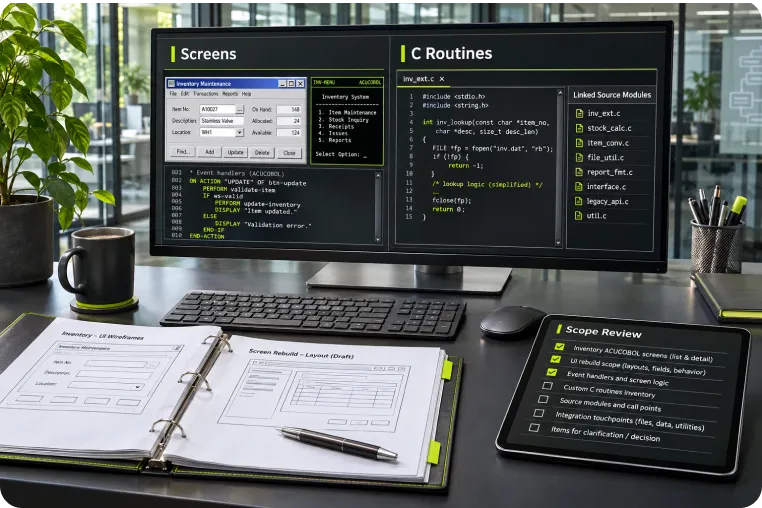
Screens and C routines listed in an ACUCOBOL scope review

How an ACUCOBOL migration runs

Step
What happens
Step1. Assess
What happensWe inventory programs, copybooks, build scripts and compile flags, XFDs, runtime settings, library calls and screens, and size the translator configuration against your real code. You get a fixed-price quote.
Step2. Configure
What happensWe tune the translation rules on a copy of your code. Your team keeps working. You review sample output.
Step3. Convert
What happensA fresh snapshot converts in one automated pass, so every change made during the project comes across. No code freeze.
Step4. Verify
What happensACUCOBOL and the new system run the same inputs side by side. Outputs, files and status codes are compared until there are no unexplained differences.

ACUCOBOL to Java and C# FAQ

General questions

Yes. DMS converts ACUCOBOL-GT and extend programs to Java, typically Spring Boot with JPA or JDBC. Vision files move to relational tables, and the compile flags each program used are applied.

Yes. The output is C# on .NET 10 with ASP.NET Core and Entity Framework Core. Threads, transactions and library routines map to their .NET equivalents.

No. The output is plain Java or C# plus a small support library you own. No COBOL runtime is needed at any site.

They move to tables on the database you choose, keeping keys, record formats and file status codes. Your XFDs guide the schema, and data migration scripts ship with the code.

Yes. Your data is already relational, so the work is turning COBOL file verbs into direct data access against the same tables.

They keep running the ACUCOBOL release until the translated version ships. After that, your product needs no COBOL runtime license at their sites.

They are listed in the assessment, and the logic behind each screen translates with the program. How the user interface is rebuilt is agreed before the fixed price.

Choose the language your team will maintain. Java runs on Linux, Windows or any cloud, which helps if customers run several platforms. C# fits products sold into Microsoft shops. The process and testing are the same.

No. DMS translates with explicit rules, so the same input always gives the same output, and every difference traces to a rule. Gen AI is used only around the edges, for documentation and test generation.

With a free assessment under NDA. Send rough line counts, your ACUCOBOL version, your build scripts and your target language. You get a complexity report, an automation estimate and a fixed-price quote.