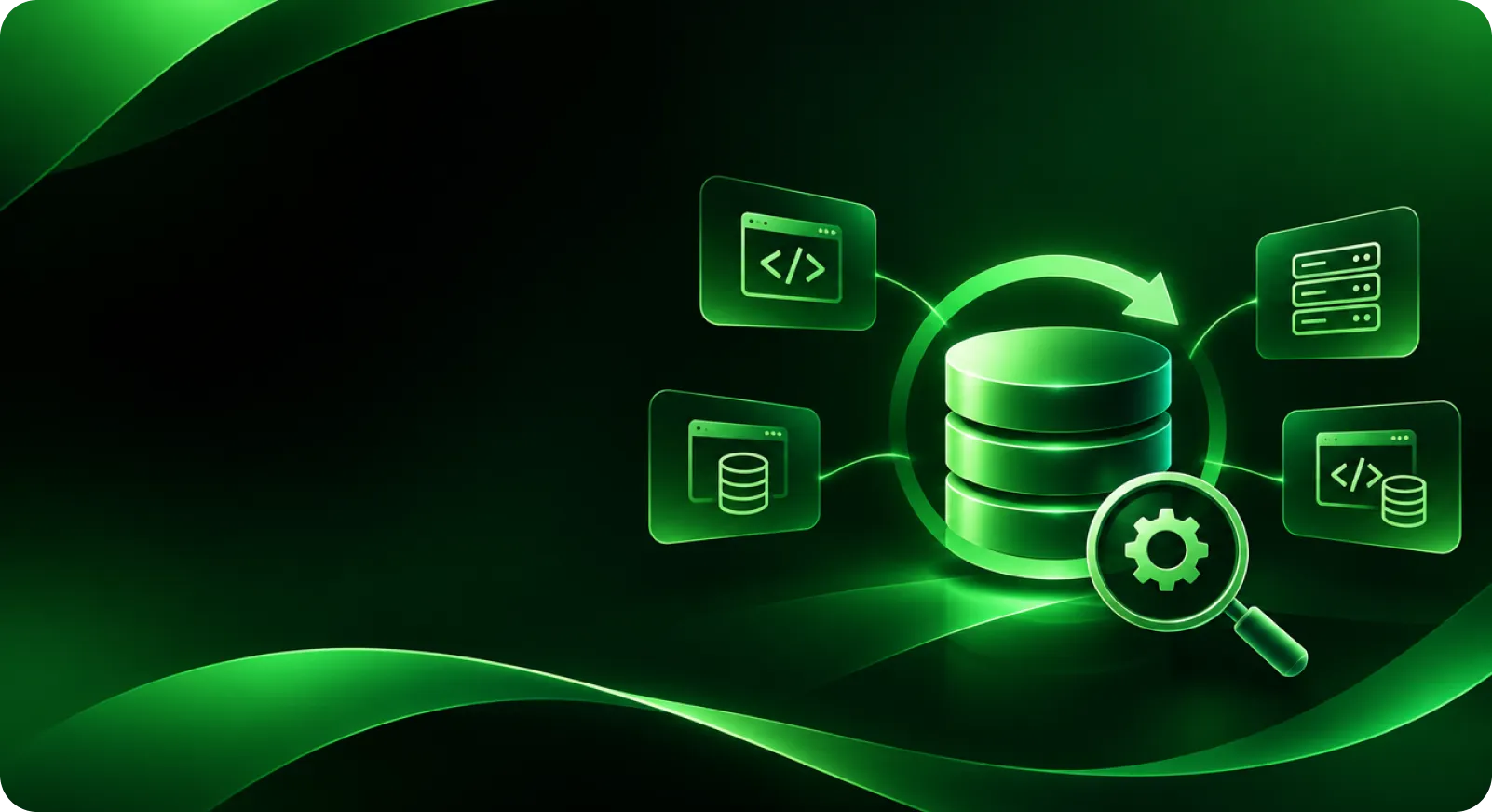
Database and code migration
The full workstream: schema, data and the programs that use it, moved together. Typical for COBOL to Java, COBOL to C# and Natural/ADABAS programs.
In a legacy system, the database and the code are one thing. Record layouts live in COBOL copybooks, keys live in program logic, and the meaning of a REDEFINES depends on which paragraph reads it. A schema converter sees the files. It does not see the code.
We modernize everything together. The value is not merely that DMS parses COBOL programs and copybooks. It is that DMS:







Most database migration services start and end at relational-to-relational. Ours starts where the data has no catalog, only code.
Targets: PostgreSQL, SQL Server, Azure SQL, Oracle, Db2 LUW and Amazon Aurora. For the full technical walkthrough, read Mainframe data migration: VSAM, IMS and DB2.
To be clear: if you are moving Oracle to PostgreSQL or SQL Server to Azure SQL, AWS DMS and the schema conversion tools are the right choice. They are built for like-for-like relational moves. This service is for the cases they were not built for.
DMS parses every program, copybook, Predict definition and embedded SQL statement. It reports missing copybooks, dead code and inconsistent layouts, and maps which programs read and write which records. See code analysis services.
Tables, keys, indexes and types are designed from how the data is actually used. MU and PE become child tables, descriptors become indexes, and COMP-3 fields get exact decimal types. You review and sign off on the schema before anything moves.
We generate unload, normalize and load programs that decode EBCDIC, unpack packed decimal, resolve REDEFINES and split repeating groups. The schema decisions that drive these programs also drive the code conversion, so data and code stay in step.
Every load is reconciled against the source. Then legacy and modern stacks run on the same inputs and results are compared until differences are explained and closed.
The full workstream: schema, data and the programs that use it, moved together. Typical for COBOL to Java, COBOL to C# and Natural/ADABAS programs.
Your application language stays. File and database calls are rewritten against the new relational schema, so the code migration can come later, or not at all.
We generate and hand over the unload, normalize and load programs and the reconciliation checks. Your team runs rehearsals and cutover on its own schedule.
Moving rows is the easy part. We convert the embedded SQL in the programs that query them, so the application runs against the new engine.
Show us your copybooks and we will show you the schema hiding in them.
Book a free database assessment →General questions
It means moving legacy data stores such as VSAM, IMS, ADABAS, DataCom, Model 204, Enscribe and DB2 for z/OS to a modern relational database, together with the code that reads and writes them. We design the target schema from the record layouts and the programs, generate the data migration programs, rewrite access path, and reconcile the results. The database and the application are treated as one workstream, because in legacy systems they were never separate.
AWS DMS and schema converters move tables, rows and SQL objects between relational engines. For Oracle to PostgreSQL, use them. They do not read COBOL copybooks, resolve REDEFINES, split ADABAS periodic groups or rewrite the programs that navigate records one at a time. Our engine, DMS (Design Maintenance System, is not unrelated to AWS DMS), parses the application code and the data definitions together, so the schema and the code change in step.
DMS support includes VSAM (KSDS, ESDS, RRDS), IMS DB, ADABAS, DataCom, Model 204, Enscribe and SQL/MP on HPE NonStop, DB2 for z/OS, flat files and denormalized VB6-era data. Targets include PostgreSQL, SQL Server, Azure SQL, Oracle, Db2 LUW and Amazon Aurora. the specific migration mapping is established during assessment.
Packed decimal (COMP-3) becomes C# decimal or Java BigDecimal, with precision and scale taken from the PIC clause. REDEFINES are resolved by tracing which programs read which overlay, and each variant gets an explicit representation. EBCDIC text is converted during the load, and where the business logic depends on EBCDIC sort order, we preserve it with ordinal comparison against an EBCDIC sequence. OCCURS DEPENDING ON lengths are resolved at runtime.
Every load is reconciled three ways: row counts per source file and target table, control totals on amount and key fields, and field-level comparisons between decoded source values and target columns. Then the legacy and modern systems run in parallel on the same inputs and their results are compared. Differences are traced to a cause and fixed in the rules, not patched by hand in the data.
It can be, if record-at-a-time code is pointed at a relational engine without tuning. That is why performance is part of the engagement. We profile the converted application, rewrite slow access paths, and tune indexes before cutover, with a target of 1:1 or better throughput against your legacy baseline. Batch elapsed times and transaction response are measured during the parallel run, not guessed.
No. Your team keeps maintaining the legacy system while we build and tune the transformation rules. Because the process is deterministic, we re-run it on the latest code and data definitions before each delivery, so changes your team makes along the way are carried forward instead of frozen out. The data migration programs can be rerun for every rehearsal and for the final cutover.
The core is deterministic symbolic AI: compiler-grade parsing, data-flow analysis and rewrite rules that produce the same output for the same input. Gen AI works around that core, helping with documentation, business-rule extraction, comprehension of unfamiliar code, summaries and test generation. It never decides how a field is typed, how a record is split or how a transaction boundary is drawn.
Yes. DMS can be run on your own Linux or Windows servers, on-prem, Your data never has to leave your site. Every engagement starts under NDA. You own the converted code, the schema, the DDL and the generated data migration programs. There are no runtime royalties.
We start with a free codebase assessment under NDA: a complexity report, an automation estimate and a rough timeline. Then if appropriate we’ll conduct a full assessment and proivde fixed price for the engagement shape you choose.

 info@semanticdesigns.com
